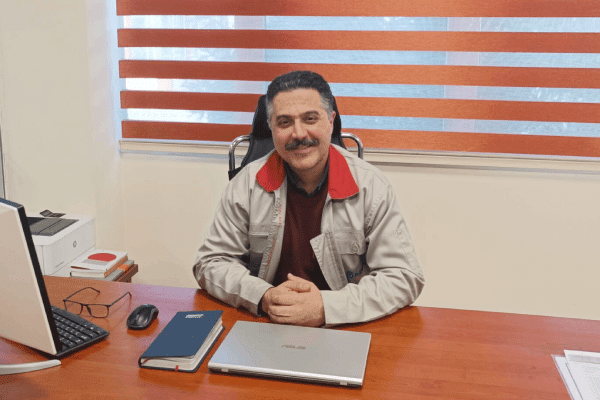
Please introduce yourself to the Plus Mag audience:
Personally, despite always having red lines for myself, I am an emotional person; I am very interested in reading, especially psychology books; I am a sports fan, I watch a lot of football, but I play ping-pong more professionally. In terms of my job, I started working in the industry in 2001 and experienced various responsibilities, including supervisor and head of production at Pars Khodro and head, manager and deputy head of production at Mammut. Obviously, during these years, I was constantly looking to increase my skills and knowledge as needed; including acquiring lean production and production systems skills, some of which I had spent in the country and some in European countries. My efforts and the trust of the senior managers of Mammut Group ultimately led to my transfer to Raman in July as the Executive Deputy CEO, and by the grace of God, in this short period of time, with a very strong teamwork with all the children of Raman, we were able to do good things in this complex.
It is obvious that you have overcome many challenges in your ups and downs in your career. Please mention one of the most important challenges you faced in these years:
There is always a challenge or issue at work, especially in a complex like Mammut, where agility, speed and being the best are always a priority. Consequently, the challenges are more and of course, in my opinion, every challenge is a new opportunity. But
The most important challenge for me, when I first joined Mammut, was adapting my own mentality and work model in moving from a state-owned company to a private company. A change in which I had to use all my learnings in the best way and do the job in the best way.
What factors have been effective in your growth and success in this organization?
In my opinion, the most important factor is motivation. It may sound cliché, but it is very important to have enough motivation to grow and excel. In the book Creating Motivation for Employees, I read that motivation is an internal force that guides people’s behavior towards achieving goals, leads to performance and makes employees more efficient; this doubles the importance of motivation. Another important factor is taking the right first step and having a commitment on the path. The difference between a dream and a goal is being committed to your desires and even changing your own life to achieve the goal.
Another factor that has always helped me in this direction has been two-way communication with colleagues, and I owe this to my work experience at different levels of the organization; I have played various roles for years and have experienced the process that must be followed to perform a task or prepare a report. Therefore, today, when I want such a report, I know where the work may be a little difficult, where the possibility of error and what risks there are in each issue, so I am familiar with the ins and outs of the work while empathizing with my colleagues. Peter Drucker writes in an article entitled Characteristics of an Effective Executive that for managers to be successful in their performance, they think in the best interests of the organization, they learn the necessary knowledge about the work, and most importantly, they themselves participate in the action and monitor it. I also try to spend most of my time on the production line, following up on issues while working and in the line of operations.
What is your opinion about new ideas in the organization and how should these ideas be nurtured?
Let me continue with a famous saying, people throw stones at a moving train, what does it mean? Whenever you feel that there is no pressure or difficulty on the path, doubt the novelty and correctness of that path. Many good ideas all over the world, when they were proposed, were met with laughter or indifference from managers or investors. For example, successful startups in the world are attractive because they faced many obstacles in the beginning, even with laughter and mockery, but in my opinion, if you have an idea and no one laughs at it, know that your idea is not new and maybe not even a very good idea. The rest of the work to cultivate these ideas, along with the support of managers, is perseverance, energy, and commitment to the goal we have in mind, and without these requirements, no idea can be realized.
Can you give our audience an example of the innovative work that you and your team have done recently?
At Mammut, we have a motto that we all believe in with all our hearts, in every position and responsibility, “To be the best at what we do”; this is not just a sentence, it is a culture that drives many innovative actions within the company. There are many examples of these innovations, and I will mention one of them.
One of the innovative actions that was recently carried out and resolved one of the production bottlenecks was the conversion of the CTI warehouse into a production line for the killer within 30 days, where it was supposed to remain as a warehouse for the time being, and to date, about 900 killers of the highest quality have been produced there.
When I took on the executive responsibility at Raman, the need to create a second production line was very much felt, and so we decided to implement this idea. When we first called our colleagues and said that we wanted to do this and turn the CTI hall into our own production line, it still seemed impossible or very difficult, but we launched this line with the lowest costs, facilities, and production concepts that we had learned over the years, and solved one of the organization’s major problems.
What made this innovative move even more attractive to me was the sympathetic cooperation of all the teams in all the companies under the group to achieve this goal. From Mammut’s technical colleagues to Mammut Technology colleagues, everyone helped to bring this idea to fruition, and I am both grateful and happy for that.
Given the importance of human resources and human resource leadership, please share your opinion on this matter with Plusmag readers: Sir Alex Ferguson writes in his book Leadership: “You certainly can’t expect the best performance from people by beating them with an iron rod, but you have to do it by showing them respect and convincing them of their ability to improve. If you don’t understand people, it will be very difficult to motivate them.” Ferguson continues with an interesting memory of meeting a Scottish boy and the lesson he learned from him: When I was the Aberdeen manager, we went to Glasgow every Thursday night to train young players on one of the Astrotoff fields and in this way we could identify the best talents. One night I was there, wearing an Aberdeen sweatshirt, and I saw an eight-year-old player smoking. I said to him, “Put the cigarette out, boy!” What would your father think of you if he saw this?” The boy looked at me and said, “Go on!” and walked away. My assistant, Archie Knox, who was with me at the time, burst out laughing when he saw my loss. But when I thought about it carefully, I realized that I knew nothing about the boy. I didn’t know where he was from, who his parents were, and… If you don’t know these things and don’t understand the character of the person, it will be impossible to get the best out of them. After that, before signing any player, especially the younger ones, I always tried to understand their development. The first ten or twelve years of a person’s life have a very profound effect on their behavior in adulthood. With this story, I wanted to point out one of the important characteristics of leaders, which is understanding the character of the situation and the character of others.
I also gained special experiences in this field at Mammoth; Early in my career at the company, when we had a very heavy foreign production order and we were all trying to meet our daily production targets and pack the export cargo, I saw a man who was as busy as all of us and was following up on each and every task from each of the children. For the first few minutes, I didn’t know who he was, but I soon realized that he was my father’s engineer. When I saw how much he was there with us and how much he guided us in doing things, I learned that leadership is much more successful by observing and being in the field. As I said before, working at different levels of the organization can be a key to success. For this reason, I strongly believe in succession planning and promoting people within the organization to the highest levels of senior management. But leadership is not always about managers. In my opinion, Mammoth is a different world. For example, when I talk to old Mammoth colleagues, I see many of them as heroes and leaders of Mammoth. Of course, thanks to God and the good leaders of the organization, this spirit is also being propagated and developed in new colleagues. I know colleagues who have never thought that they are employees here and always behave like family. Finally, I must say that the essence of leadership is, in a word, working with people’s hearts, and this feeling and spirit in Mammoth today is a sign of the correct leadership of Engineer Ferdows Sr. What advice do you have for new managers to advance organizational goals? An important point that I remind new managers is that never be a spokesperson for your people, and my friends have heard this sentence from me many times. In the early days of work, a manager should not hear one thing and convey the same thing; A manager must analyze the current situation before taking any action and then make a decision. In the book Ten Essays on Leadership from Harvard, I read that Napoleon said somewhere, “Perhaps successful battles do not always go exactly according to plan, but I always examine all the conditions before each battle and make the best decision with my generals.” Finally, let us remember that we should not confuse management with sitting behind a table.
As a final note from the audience’s perspective, what is your opinion about Plusmag magazine?
It is great that this magazine pays attention to all levels of the organization, and being seen in the operational levels of the organization is very valuable and motivates the staff. In my opinion, this culture of innovation and striving to see all people who perform their roles well is one of the very good missions of Plusmag magazine. This goal, along with useful, practical content and research on the research needs of Mammoth Group companies, has made the magazine useful and practical.