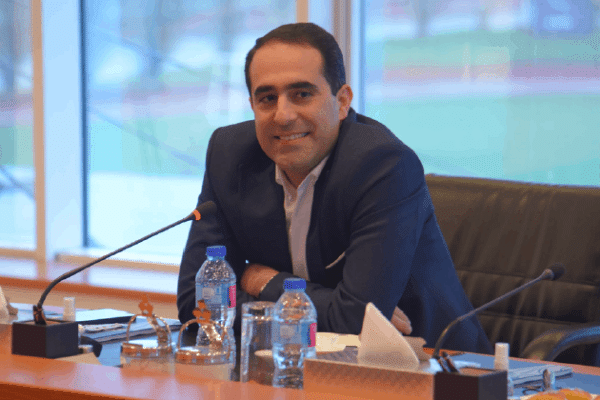
Please introduce yourself:
And I have been working at Moazam Mamut Group for about 10 years. As soon as I finished my engineering course, I went to Assaluyeh and worked as a project control employee at the South Pars operational sites for about 2 years. Working with Japanese employers at that time was very instructive for me, and their commendable work culture in project management was full of learning for me. Then I returned to Tehran and worked in the automotive industry at Pars Khodro Company. I started my work at that company from the assembly hall floor, and the Renault product launch project at that time provided me with the opportunity to work closely with French Renault experts; it was truly a practical university. One of the most beautiful concepts that I learned while working closely with Renault was Kaizen, which means continuous improvement in the form of creativity and innovation on the workshop floor. Since 2013, I have been working at Mammut Group as the Deputy Head of Parts Manufacturing, which was known as Production 3, and I have always tried to provide a basis for improving the working conditions and better morale for my colleagues in the workplace by valuing innovative activities. One of the manifestations of this is the Kaizen Festival, which is held every year to appreciate the creative ideas of the staff, and this is the beginning of our movement on the path of innovation.
How do you define innovation? Does innovation necessarily have to end in a new product or can it be a simple solution to do things better?
The meaning of innovation is different for different people. In fact, in the present era, this word is used more than any other phrase in business. There are hundreds of definitions in this field that originate from different angles and different disciplines, some of which focus on processes and others on outputs. But in my opinion, the world of innovation goes beyond new products on store shelves or various services on the Internet. Innovation can be a culture, it can be a function of the organization, it can even be the macro strategy of a company.
But to be more precise, in the business world, innovation is the ability to imagine, develop, deliver and scale new products, services, processes and business models for customers.
Perhaps it would be good to examine the nature of innovation in the words of Michael Porter, an expert in the field of technology, innovation and management. He says: “Companies achieve a competitive advantage through innovation that includes both new technologies and new ways of doing things.”
Do you have to be like Steve Jobs or Elon Musk to be innovative?
It comes down to our way of looking at things; first of all, we are just like ourselves; how realistic and perfectionist we are in our personal lives. Basically, we have an innovation and an innovation theater in the technology market; which are different. I will leave the innovation theater aside and not talk about it. In today’s world, there is a lot of noise about innovation, whether open or closed or organizational. If you get to the bottom of it and know what’s going on behind the scenes, you’ll realize that it’s really part of the theater of innovation. As the French say, at the end of the day, no value is created, and no customer is happier or more satisfied. But there has been some noise; I always say that they have a fancy showcase, but it’s not clear what’s going on in the warehouse. So in many cases, it’s not easy to measure the effectiveness of companies’ innovative actions and their impact on customer satisfaction. We have people who are innovators and entrepreneurs. Some are also entrepreneurs. People like Steve Jobs or Elon Musk are both personal innovators and organizational innovators. They are very few in the world. They are very exceptional and special. Therefore, it is better not to try to be like one of them in order to chart the innovation path of our organization, while innovation may consist of smaller entities and each person completes a piece and ultimately the innovation puzzle of our organization is built. A puzzle that is not similar to the Apple or Tesla puzzle. For example, we give a product to a customer, one person may innovate in the product and another person may innovate in the business model of that product. In total, an innovative process or product is obtained, each part of which was carried out by one person. Some people do not consider innovation in organizational processes to be a type of innovation and think that only those who have launched a specific product in the form of a startup are innovators. Many great innovations are the product of the work of several people with a team and are mentioned as exemplary examples of innovation in the long run. Therefore, we can say that everyone has the ability to do creative work and innovate at different levels.
What do you think about artificial intelligence and the talk these days about its dangers?
“A few days ago I heard news that a global organization is going to be formed to control the use of artificial intelligence.”
Exactly the same as what was previously prepared for nuclear energy. Perhaps this is a hint that the use of such technologies can also be dangerous. But such topics are mostly raised in discussions of the philosophy of technology and concepts such as the technological singularity, and I believe that in any case, even if it is dangerous, a way will be found to use its benefits more than its dangers.
Artificial intelligence has the potential to transform many industries and improve our daily lives, but its risks must be carefully examined and managed. In general, any knowledge must be managed to serve humanity. Even the use of cars, which have become an integral part of our lives today, will be more dangerous than useful if not used according to the right principles and rules. Undoubtedly, with the emergence of new sciences, standards for their correct and intelligent control will also be defined. Jürgen Schmidt-Huber, a man once described as the father of artificial intelligence, tells many of his contemporaries who fear the AI arms race: “What is happening is inevitable, but we must learn to embrace it.”
The truth is that a revolution has occurred. This revolution is the result of remarkable innovations in many areas such as hardware, software, networks, and technologies such as big data and artificial intelligence. The Internet and the Web have fueled the emergence of online communities and distributed teams that interact in entirely new ways. Movements like open source, open innovation, and open collaboration have transformed the way we think about business. At the same time, flexible work models and remote work have emerged in the gig economy, and entrepreneurial and startup initiatives are emerging.
What’s driving the mammoth drive to innovate?
As we speak, there are an estimated 5 billion active Internet users and more than 30 billion connected devices in the world.
“We live in an era of unprecedented access to knowledge, creative power, and digital resources.”
This modern era is characterized by a vast and ongoing transformation that affects every aspect of human life, from education and health to entertainment, travel, and transportation. In the business world, digital technologies have created similar effects, changing the way we work and how we build products and deliver services.
Do you draw inspiration from a personal role model in your work life?
If we consider role modeling as knowing, using successful experiences, and drawing inspiration from a specific person, I (like many senior managers at Mammut Group) always benefit from the teachings of the late Engineer Behrouz Ferdows, whom we all know as Engineer Father, and this name is very fitting for him, both in terms of knowledge and spirituality. He always sought development, creativity, and innovation in the organization, and the remarkable development of Mammut Group is due to his innovations and the support of a valuable team that was committed to these goals alongside him.
In general, the Ferdows family is one of the best and most professional entrepreneurs in our beloved country that I know in the entire industry, and their professional behavior with different levels of the organization has always been an inspiration to me.
What is the place of digital transformation and data-based technologies in the future of Mammoth?
The new order in the fields of technology, culture, and communications has provided amazing opportunities for radical and incremental innovation. At the same time, the innovation process has also become faster than in the past, and a large part of the competition of companies is clearly based on innovation. Among these, companies that have both knowledge and a desire to innovate have a distinct advantage over other risk-averse companies.
As an innovation-driven organization, we have the chance to be in the middle of the game and at the forefront of growth. It is obvious that companies that ignore the value of innovation or do not behave as they should will eventually disappear.
We are determined to transform our organization using a new model of innovation and digital transformation.
In this model, innovation is a core capability of the company, fully embedded in operational aspects and well aligned with the company’s mission. To be present in the digital age, we must be able to adapt quickly to changes and reorganize our working methods, communication, interaction and expected financial results. We have established an Innovation and Acceleration Center that will lead the way in implementing interactive programs with startups, scientific and academic institutions in these areas and can strengthen our innovation ecosystem so that our market-leading companies can make the most of these innovation opportunities.